
How AI Tools Are Reshaping the Modern Software Development Lifecycle
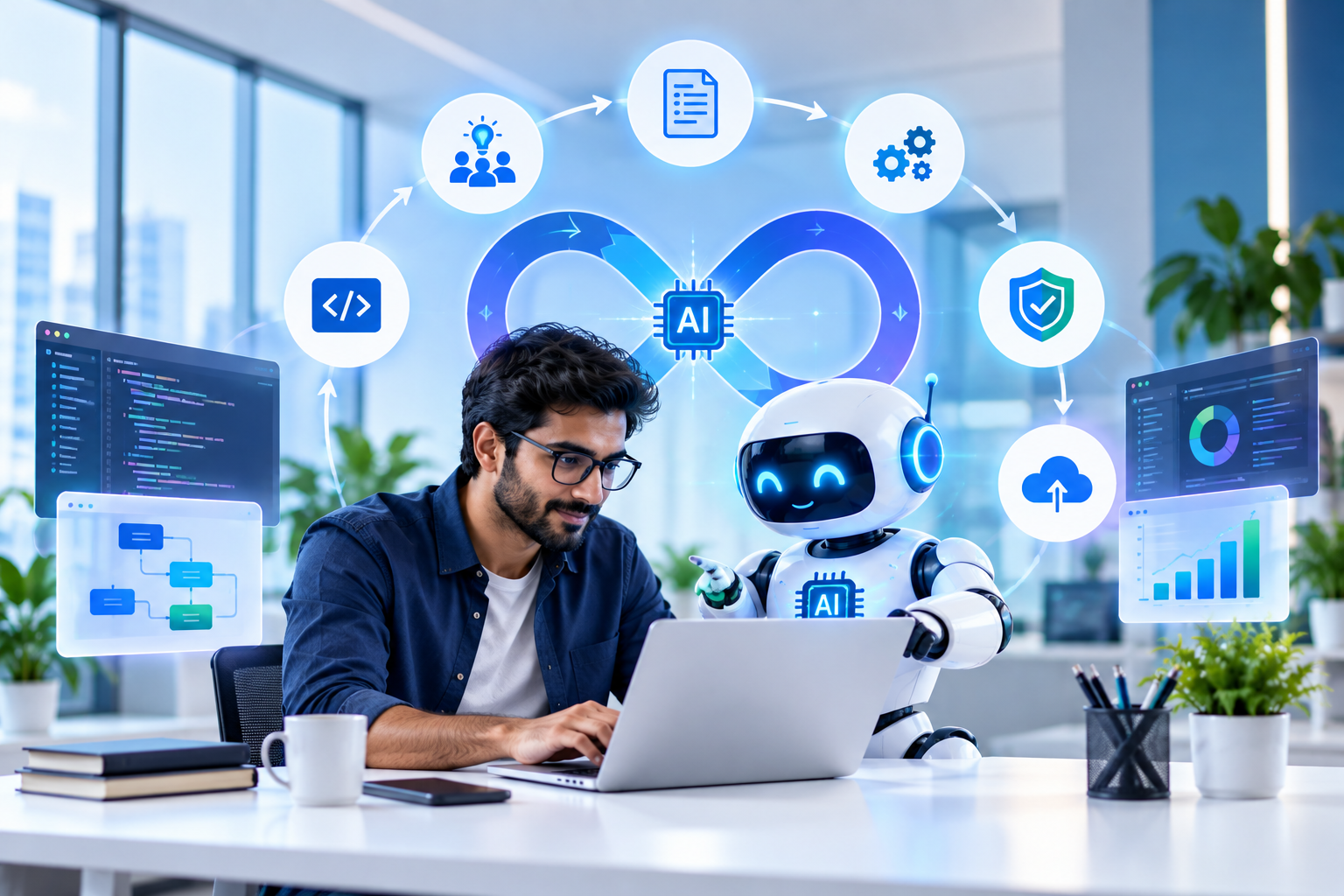
- Drastic reduction in boilerplate coding and repetitive setup tasks
- AI-generated unit and integration tests that catch subtle regressions early
- Transition of developer roles toward system architecture and domain logic
- Crucial need for rigorous human review to prevent security vulnerabilities
Artificial Intelligence is no longer just a futuristic concept in software engineering—it is an active pair programmer sitting alongside modern developers. From code generation assistants to automated debugging systems, AI tools are fundamentally accelerating the software development lifecycle (SDLC).
Instead of replacing software engineers, AI is automating boilerplate workflows, allowing technical teams to concentrate on system architecture, business logic, and security.
1. Accelerated Code Generation and Prototyping
AI-powered code completion platforms analyze context across entire repositories to suggest functional code snippets, boilerplate patterns, and syntax corrections in real time.
Faster ramp-up: Developers can translate high-level requirements into boilerplate setups within minutes.
Context-aware completions: Modern models suggest entire functions and test cases tailored to the existing project structure.
2. Automated Testing and Bug Detection
Finding edge cases and writing comprehensive unit tests can consume up to 40% of development time. AI tools can now parse codebases to automatically generate test suites.
Edge case discovery: Machine learning models flag potential runtime errors, null pointer risks, and unhandled promises before deployment.
Automated refactoring: Systems detect code smells and propose cleaner, more performant alternatives directly inside pull requests.
3. Shifting Developer Focus to Architecture
When repetitive tasks like writing CRUD operations and parsing syntax are automated, the developer's role naturally evolves.
High-level system design: Focus shifts toward microservices design, latency reduction, database schema efficiency, and cloud cost management.
Code review & security governance: Developers act as curators and auditors, ensuring generated code meets strict security and compliance standards.
4. The Human Element Remains Critical
AI outputs are only as dependable as the prompts and requirements fed into them. Hallucinated APIs, suboptimal algorithmic choices, and hidden security vulnerabilities mean that engineering judgment, domain expertise, and rigorous manual reviews remain indispensable.
More from our studio